
Bicycle Tires
Tire choice is based on a relationship between durability, speed and comfort. I think the goal for most riders is to sacrifice as little durability and comfort to speed as possible.
Tire Construction
My research concerning tire construction and its relationship to speed, durability and comfort has identified the following factors that affect each of these issues.
Slick versus Tread: Slick tires are faster than tires with tread. Unless you ride on dirt, there is no reason to use tires with tread. The relationship of tire width, load and speed for bike tires is not sufficient to make hydroplaning an issue. Finally, if you ride a trike where your ear is near the tire you soon realize that tire tread produces noise and is a signal that energy is being lost.
Puncture Protection Layer: A kevlar or puncture protection layer helps resist puncture flats. It adds some weight but is worth every ounce. Some of the new fabrics are very light and tough as found in the Schwalbe Ultremo.
Weight: As weight goes up, acceleration in a sprint goes down and climbing slows. Tire weight occurs at the perimeter of the wheel and therefore produces a greater affect than simi liar weight added at other points in the bike. Smaller wheels accelerate faster but larger wheels maintain speed better. Weight is a positive in maintaining speed or momentum.
Supple versus Stiff Side Walls: Supple side walls minimize energy loss produced by the tire as it deforms during the rolling process. Supple side walls produce a more comfortable ride. Stiff side walls are generally more durable.
Soft versus Hard Tire Compounds: Hard compounds increase durability while softer ones increase traction. Many road tires have harder centers for durability with soft sides for cornering traction. Hard compounds contribute to a wheel bouncing over small road imperfections with associated loss of energy. Soft compounds deform around small road imperfections and reduces wheel bounce and energy loss.
Tire Inflation & Rolling Resistance
Over inflated tires cause wheels to bounce over road imperfections. The bouncing uses energy and reduces speed. Correctly inflated tires tend to deform around road imperfections reducing energy loss.
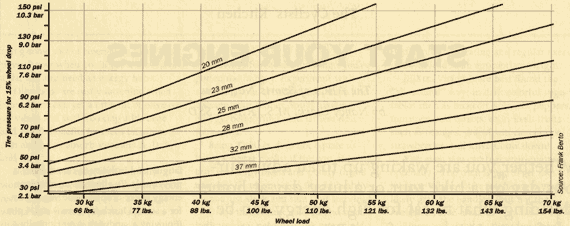
The preceding chart, based on information from Frank Berto, was published in an article titled "PSI RX" by Jan Heine in the March 2009 issue of Adventure Cyclist magazine.
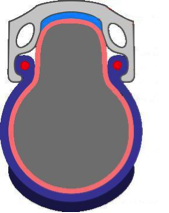
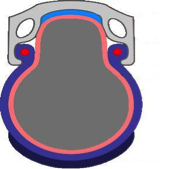
In the article, Jan Heine reports that the result of testing by Bicycle Quarterly demonstrated that performance/speed increases with an increase in tire pressure up to the point that corresponds to about a 15 percent tire drop. Tire drop refers to the difference in tire height before and after loading - before and after you sit on the bike. The chart provides a way to determine the tire pressure that will yield a 15% drop for various loads and tire widths. The loads are for each wheel not the entire bike. Use the following link to open a bigger version of the Inflation Chart (gif).
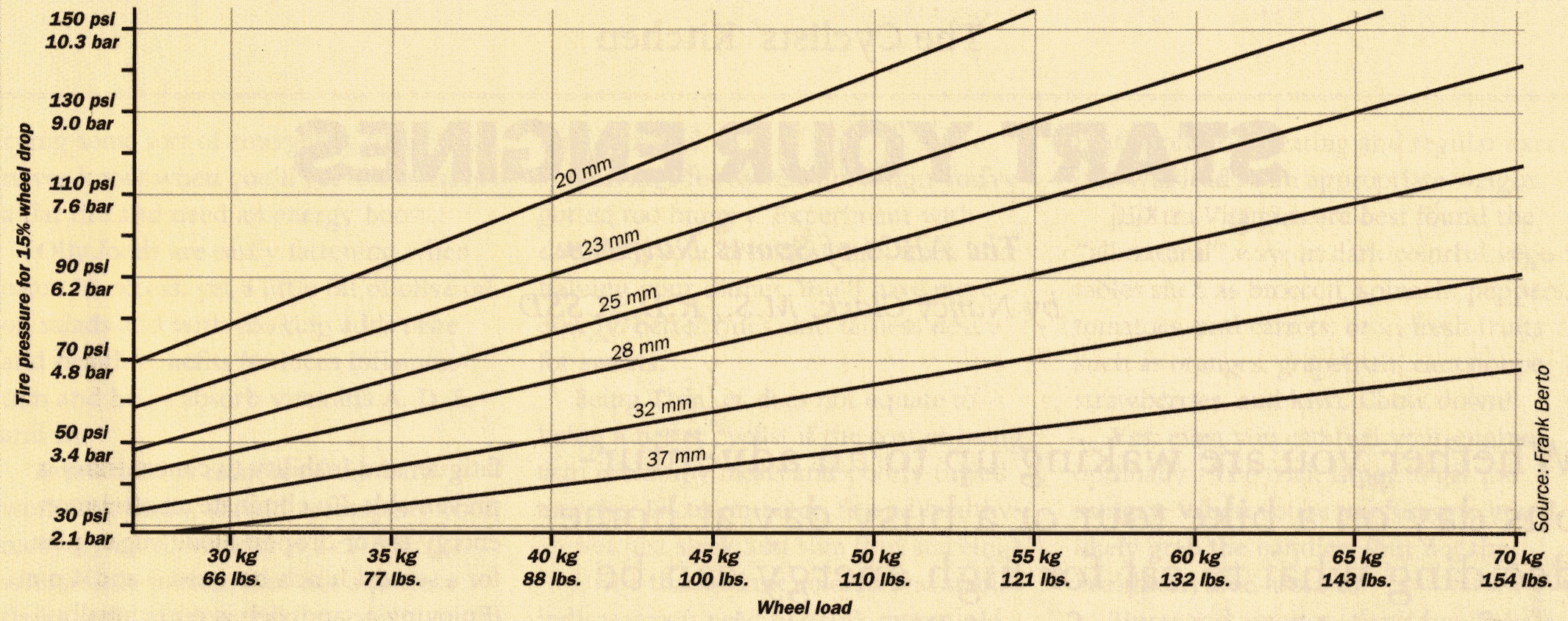
I found the article by Jan Heine very interesting and used it to examine my tire inflation practices that have consisted, to this point, of just pumping my tires up to their maximum specified pressure. I created blocks that were the same thickness as my bathroom scale and put them under the wheels not on the scale to determine wheel loads. I then plotted them on the chart to determine the desired tire inflation. I did some rounding to make the things easier to remember and produce. For example, on my ICE Votex trike I use 20 psi for the Kojak 50 mm back tire, 40 psi for Kojak 35 mm tires, 60 psi for Durano 28 mm tires and 80 psi for 23 mm Ultremo tires. I weigh 180 lbs and the trike weighs 35 lbs. I used 75 lbs for the front wheel load.
My floor pump was off by 10 plus psi so I would recommend that you test your pump against a digital tire pressure gauge if you are interested in implementing a more precise tire pressure program.
Wheel & Tire Size
Wheel size terminology can be confusing in that a mix of metric French and inch British systems is used. It is further complicated because traditionally the wheel size was designated by the outer diameter of the wheel but this measurement depends as much on tire width as it does rim diameter. It is much simpler to use the more logical system adopted by the International Organization for Standards (ISO). This system uses a wheel's bead-seat diameter—the diameter of the rim in the place where the tire seats—to define a wheel's size.
A 26" wheel has a bead-seat diameter of 559 mm.
A 650B/27.5" wheel has a bead-seat diameter of 584 mm.
A 700C/29" wheel has a bead-seat diameter of 622 mm.
It can be more confusing for smaller 20" wheels that usually have a bead-seat diameter of 406 mm but also come with a bead-seat diameter of 451 mm. In this case you need to check the ISO designation on a tire to make sure it matches your wheel.
Rolling Resistance
Bicycle Quarterly "tested different wheel sizes on various surfaces with a power meter in a carefully controlled experiment. They found that there was no difference in speed between the three popular wheel sizes (26 inches, 650B, 700C), even on equivalent cobblestones and certainly not on smooth pavement."
Jan Heine, "Wheel Size Matters" in Adventure Cyclist magazine, February 2013.
Rolling resistance is affected by tire construction and inflation as noted above.
Handling
In another Bicycle Quarterly test "all riders independently found that they preferred smaller wheels for wider and heavier tires, and larger wheels for narrower, lighter tires."
Jan Heine, "Wheel Size Matters" in Adventure Cyclist magazine, February 2013
When they calculated the rotational inertia of the preferred wheel/tire combinations they found that the values were similar. Riders were choosing a rotational inertia that balanced stability with handling—higher rotational inertia increases straight line stability while lower rotational inertia increases handling quickness.
Based on their test they concluded that:
700C wheels are best for tires up to about 30 mm wide
650B wheels are best for tires between 30 and 40 mm wide
26 inch wheels are best for tires over about 40 mm wide
This coincides with my experience with wheel sizes of 20", 24", 26", 650 and 700C on my high racer.
Rim & Tire Width
The following defines the range of tire sizes that can be used on each wheel based on rim widths. The tire sizes shown in bold are the ones use on my bikes.
19 mm Wide Rims (Velocity AeroHead, Deep V & Fusion) (13 mm inner rim width): 18, 20, 23, 24, 25 & 28 mm tires. This is the range of tire dimensions that will work on most road bikes. 23 mm tires are by far the most common. 28 mm tires are much more comfortable.
24 mm Wide Rims (Velocity AeroHeat) (19 mm inner rim width): 28, 32, 35, 37 & 40 mm tires. This is the rim width used on most trikes. The 35 mm Schwalbe Kojak is a great tire in terms of both comfort and speed.
A general guideline is that the tire width should be between 1.45/2.0 times the inner rim width. Therefore, an inner rim width of 13 mm can take tires ranging from 19 mm to 26 mm and an inner rim width of 19 mm can take tires ranging from 28 mm to 38 mm. This guideline is conservative and the maximum width can be exceeded without problems.
Cadence
The speed you turn the pedals is called cadence. You measure cadence by counting how many times your right (or left) leg completes a full revolution in one minute. Under most conditions it's usually most efficient to pedal at around 90 revolutions per minute (rpm). When you turn the pedals at a slow cadence you fatigue more quickly. When you get into the low to mid 80 rpm range you're pretty close to the sweet spot. Pedaling at this cadence for long periods of time takes practice, so be patient and keep at it.
Trike Tire Alignment
The toe on a trike should be neutral when the rider is seated on the trike. The following link takes you to a YouTube video showing the process for adjusting the toe on a TerraTrike.